Product
Retrieval That Costs Zero Tokens
Ask a memory tool a question and watch your bill. For most of them, every lookup is a model call underneath. You are not paying to retrieve a fact. You are paying a model to go find one, and that cost climbs with every question your team asks.
The Oynix Team · July 7, 2026 · 5 min read
Most memory is a model call wearing a costume
The common pattern looks like retrieval but is really generation. You ask a question. The tool embeds it, searches for similar chunks, then feeds those chunks into a model that writes an answer. Every step past the first involves inference, and inference is metered.
So the price of a lookup is the price of a model call, every time. Ten engineers asking a hundred questions a day is a running meter you did not fully choose to start. Worse, the answer is a paraphrase. The model read some chunks and summarized them, which means it can smooth over the exact detail you needed or quietly invent one.
The insight is that retrieval and reasoning are different jobs. Reasoning is what a model is for. Retrieval is just looking something up. When you make a model do the lookup too, you pay model prices for a database operation.
Oynix takes the model off the retrieval path
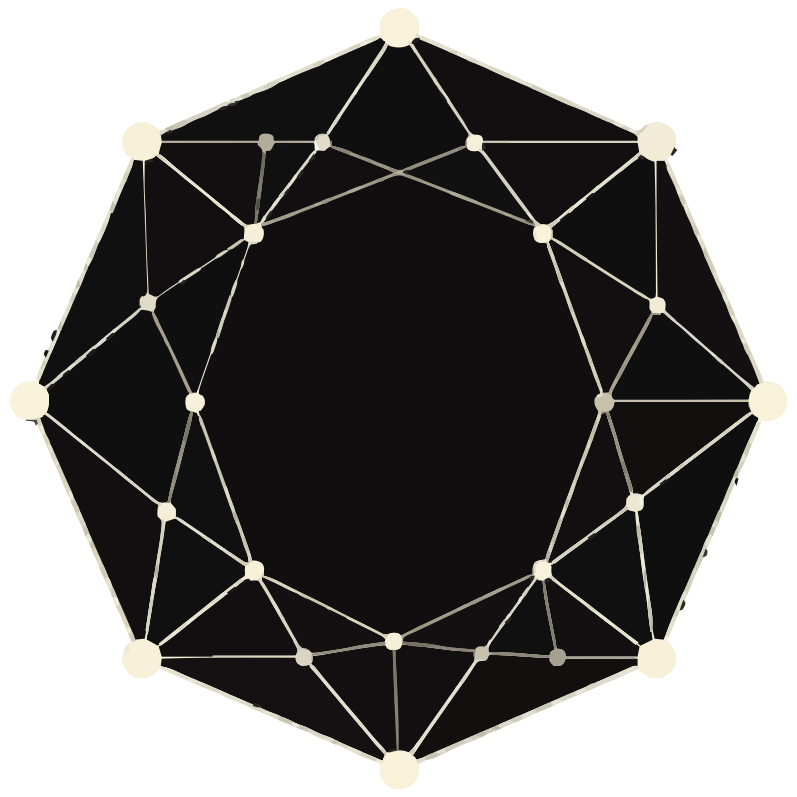
Oynix builds a knowledge graph from your code, tickets, docs, and threads. When your agent needs a fact, Oynix walks the graph and returns the exact nodes and edges. Who owns this file. What calls this function. Why this decision was made and where it was recorded.
No embedding search over the query. No model summarizing chunks. No inference on the way out. The graph is a structure you traverse, and traversal returns facts, not prose. That is why retrieval from Oynix costs zero tokens. There is no model in the path to bill for.
The reasoning still happens. It happens in your agent, where it belongs. Oynix hands over precise facts, and your agent decides what to do with them. The division of labor is clean. Oynix remembers, your agent thinks.
Two paths, side by side
Why it stays cheap as you scale
When retrieval is a model call, cost grows with questions. Double the questions, double the inference bill. That is a curve that punishes exactly the teams getting the most value.
When retrieval is a graph traversal, a lookup is a lookup. Asking more questions does not summon more inference, because there was never any inference to summon. Your cost of remembering does not scale with how often you remember.
Tokens billed by Oynix per retrieval
Oynix architecture; no model on the retrieval path
Graph traversal to return owners, callers, and reasons
Oynix product
Where the only token spend lives: your agent, your provider
Oynix product
Where your token spend actually goes
| Step | Runs a model? | Who pays tokens |
|---|---|---|
| Oynix retrieves a fact from the graph | No | Nobody |
| Oynix returns nodes, edges, and paths | No | Nobody |
| Your agent reasons over those facts | Yes | You, on your own provider key |
| Your agent writes code or an answer | Yes | You, on your own provider key |
The point of zero-token retrieval
You should pay for thinking, not for remembering. A model earning its keep on a hard reasoning problem is money well spent. A model burning tokens to look up who owns a file is waste dressed as intelligence.
Oynix draws the line where it belongs. Retrieval is free because it is not a model call. Reasoning costs what it costs, on your key, under your control. Your bill tracks the work that actually needed a brain, and nothing else.
That is the payoff. Memory that gets richer and busier without a meter running underneath it. Ask it anything, as often as you like.
You pay for thinking. Remembering is free.
Stop paying model prices to look things up
Give your agent a memory it can query all day without a token meter running, and keep your inference spend on your own key where it belongs.
Install Oynix