Knowledge
What a Knowledge Graph for Code Actually Is
Your codebase is not a pile of text. It is a web of relationships. This function calls that one. This file is owned by that engineer. This module exists because of a decision made in a ticket nobody can find anymore. A knowledge graph is what happens when you store those relationships instead of throwing them away.
The Oynix Team · July 3, 2026 · 7 min read
Most tools that read your code turn it into a heap of chunks and hope the right chunk surfaces when you ask. That works for finding text that looks like your query. It falls apart the moment the real question is about a relationship.
A knowledge graph takes the opposite bet. It keeps the relationships as first-class objects, because in a codebase the relationships are the point.
Nodes and edges, in code terms
A graph is made of two things. Nodes are the entities. Edges are the relationships between them. That is the entire vocabulary, and it maps onto a codebase cleanly.
The nodes are the things you already reason about. The edges are the connections you usually have to reconstruct in your head every time you open a file.
- Nodes. Functions, files, modules, services, owners, decisions, tickets, and chat threads. The concrete things your work is made of.
- Edges. Calls, is owned by, depends on, was changed by, explains, references. The relationships that tell you how the nodes fit together.
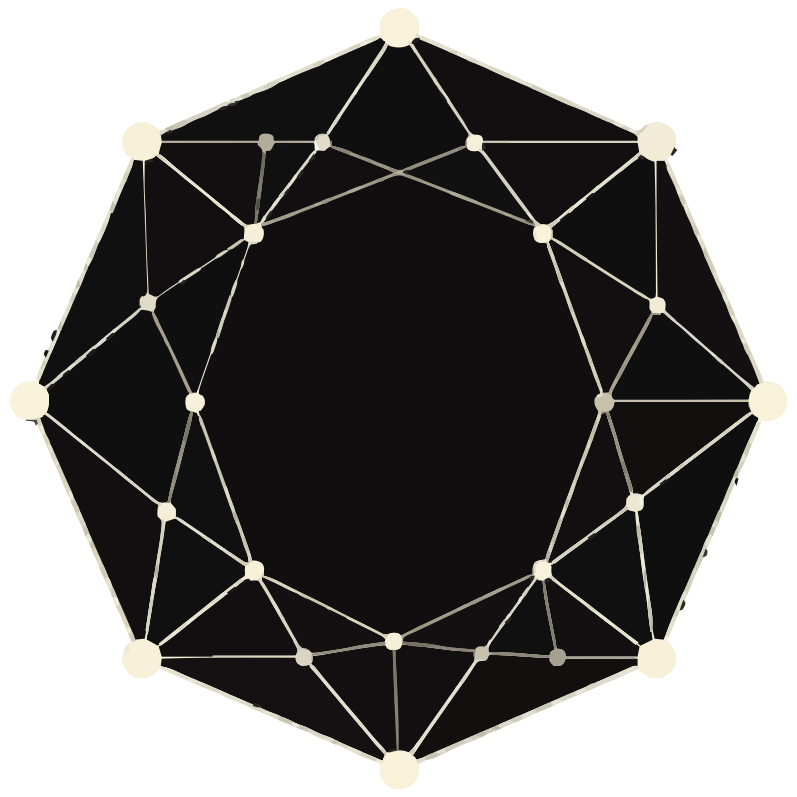
A small slice of the graph
Contrast this with a pile of embeddings
The common alternative is to convert everything into vectors and search by similarity. You embed your code, embed the question, and return the chunks whose vectors sit closest to the query's vector.
Similarity is genuinely useful for one thing: finding text that resembles other text. But resemblance is not relationship. Two functions can read almost identically and have nothing to do with each other. The function that actually breaks when you change yours might share not a single word with it.
That is the ceiling of similarity search. It can tell you what looks related. It cannot tell you what is related. For code, that gap is where the hard questions live.
| Question | Vector similarity | Graph paths |
|---|---|---|
| Find code that looks like this | Strong | Not the point |
| Who owns this file | Guesses from nearby text | Follows the owns edge |
| What calls this function | Cannot answer reliably | Follows the calls edges |
| Why does this exist | Returns similar prose | Traverses to the decision and ticket |
| What breaks if I change this | Blind to real dependencies | Walks the dependency paths |
Why paths matter more than similarity
The questions that stall an engineer are almost never about resemblance. They are about reach. If I change this, what moves. Who decided this. Why is it shaped this way. Each of those is a path through the graph, not a nearest neighbor in a vector space.
A path is an exact answer with structure. From this function, follow the calls edges to every caller. From this file, follow the owns edge to a person. From this module, follow the explains edge back to the decision and the ticket that produced it. There is no guessing and no ranking of maybe-relevant chunks. There is a route, and the route is the answer.
Search finds files. Memory finds decisions. The difference is whether your tool can walk a path or only measure a distance.
Search finds files. Memory finds decisions.
How Oynix builds and serves the graph
Oynix ties your code, tickets, docs, and chat threads into one live knowledge graph. It keeps the graph namespaced across every repository, and it updates incrementally as your code changes, so the structure stays true to what is deployed.
When your agent asks a question, Oynix returns exact nodes and the paths between them. The agent does the reasoning over those facts. Oynix does not summarize your code into prose and hope it stays accurate. It hands back the specific nodes and edges, which is why retrieval costs effectively zero tokens and why the answer is a fact rather than a plausible-sounding paragraph.
The data lives in your own database on your own infrastructure. Oynix ships the engine that builds and traverses the graph. It never holds your code.
The takeaway
A knowledge graph for code is not a fancier search index. It is a change in what you store. Embeddings store how things look. A graph stores how things connect.
For a codebase, connection is everything. The bug you are chasing, the review you are doing, the refactor you are scared of. Every one of them is a question about paths, and paths are exactly what a graph was built to answer.
Turn your codebase into a graph your agent can walk
Oynix stores the real relationships between code, owners, decisions, and tickets, then returns exact paths on demand.
Install Oynix