Comparison
Knowledge graph, vector memory, or a wiki: how should your team remember?
Once a team feels the cost of lost context, the search for a fix usually lands on one of three tools. They look interchangeable from the outside, but they store fundamentally different things — and break in different ways. A plain-English comparison.
The Oynix Team · June 19, 2026 · 8 min read
Option 1 — The wiki
A wiki — Confluence, Notion, an internal docs site — is the most human-friendly option, and for polished onboarding guides or runbooks it's hard to beat. Its weakness is structural: a wiki is a snapshot the moment it's written, and the code keeps moving.
Within a quarter, half of it is subtly wrong — and wrong documentation is worse than none, because people trust it. A wiki is the right tool when you mainly need readable prose and have the discipline to keep it current.
Option 2 — Vector memory
A newer category — memory APIs and frameworks like Mem0 or Cognee — stores your text as embeddings, so you can retrieve it by meaning rather than exact words. The semantic recall is genuinely good. But the memory is flat: it's a pile of snippets that know how similar they are to each other, and nothing else.
It can tell you two snippets are similar; it can't tell you that one function calls another, or that a decision governs a file. There's no structure to traverse, so it can't follow a call chain or explain why a piece of code exists. It's a strong fit when you need fuzzy recall over loose text and don't need to reason about how your code fits together.
Option 3 — A knowledge graph
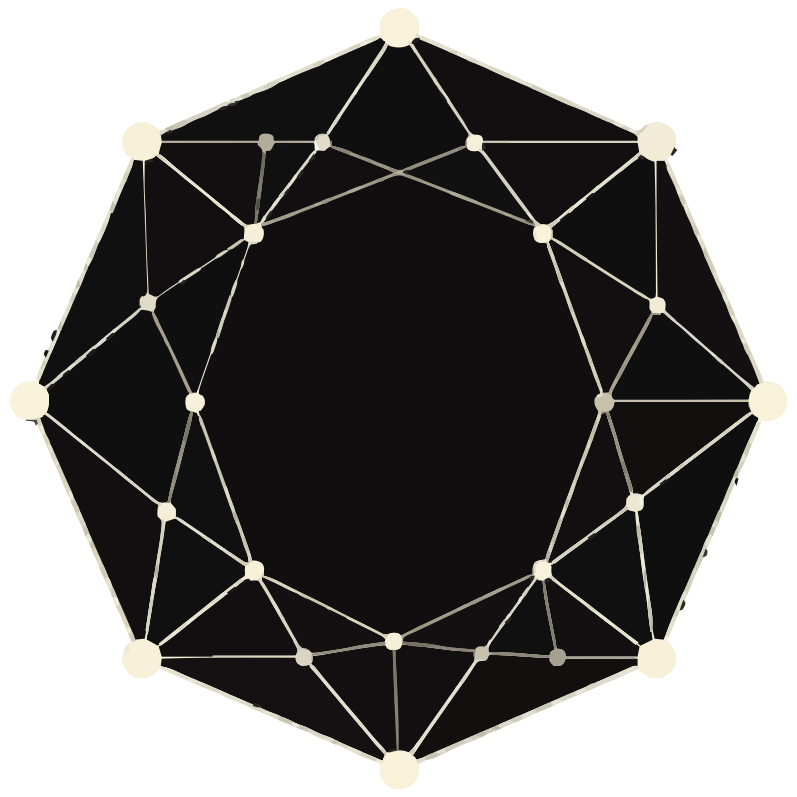
Oynix takes the third approach: it stores the structure. Your code becomes a graph of real relationships — functions, files, and the edges between them — linked to the decisions that shaped them.
Retrieval is both semantic and structural, so it can follow the actual wiring of your system, trace a real call chain, and surface the decision behind a function — instead of returning a bag of similar-looking snippets. It's the right fit when you need answers grounded in how your code actually fits together, and want your AI agents to start with that context.
Side by side
| Wiki | Vector memory | Knowledge graph | |
|---|---|---|---|
| Stores | Hand-written prose | Text as embeddings | Code + real relationships |
| Strength | Human-readable | Semantic recall | Structure you can traverse |
| Weakness | Drifts, goes stale | Flat — no connections | Needs indexing (automatic) |
| Answers "why does X exist?" | Only if someone wrote it | Only by similarity | Yes — follows the link |
| Best for | Readable docs | Fuzzy text recall | Grounded code answers |
How to choose
- Choose a wiki. if you mainly need human-readable docs and will keep them current.
- Choose vector memory. if you need semantic recall over loose text and don't need to reason about code structure.
- Choose a knowledge graph. if you need answers grounded in how your code actually fits together — and want your AI agents to start with that context.
These aren't mutually exclusive — many teams keep a wiki for human-facing docs and a graph for machine-grounded answers. The mistake is expecting flat text storage to reason about a system that is, fundamentally, a graph.
Memory that matches how code actually works
Oynix is a graph-native knowledge layer — your code and the decisions behind it, structured and queryable, for your team and your AI agents.
Join the waitlist →