Under the hood
How Oynix actually understands your code
Most "AI code tools" don't understand your code — they pattern-match on its surface. Oynix reads it the way a compiler does: as structure. Here's what that means, in plain English, and why it changes the answers you get.
The Oynix Team · June 12, 2026 · 8 min read
Searching text isn't understanding
Here's something most code tools won't tell you: they don't actually understand your code. They either search it as plain text — grep for a word — or turn it into a blurry set of numbers (an embedding) and return whatever looks similar. Both are pattern-matching on the surface.
Neither one knows that one function calls another, or that a file owns a database table. Oynix works differently. Before it answers anything, it reads your code the way a compiler does: as structure.
From text to a tree
When you write code, you see text. But that text has a hidden structure: this is a function, that's its name, these are its arguments, this block is what it does. A parser makes that structure explicit by turning each file into a syntax tree — a map of what every piece of code actually is.
Here's the analogy: it's the difference between reading a sentence letter by letter and diagramming it into subject, verb, and object. Grep reads letters. Oynix diagrams the sentence — so it knows the parts, not just the characters.
30+ languages — including the ones tools ignore
Oynix ships a purpose-built parser for each of more than thirty languages — and not only the obvious ones. Alongside Go, Python, TypeScript, Java, and Rust, it parses the files most tools skip entirely: HTML, CSS, SCSS, LESS, and Markdown.
That matters because those files are part of how your product works. A design-system token, a template, a runbook — they're not noise, they're context. Oynix turns them into first-class nodes in the graph instead of invisible files.
Symbols become a graph of relationships
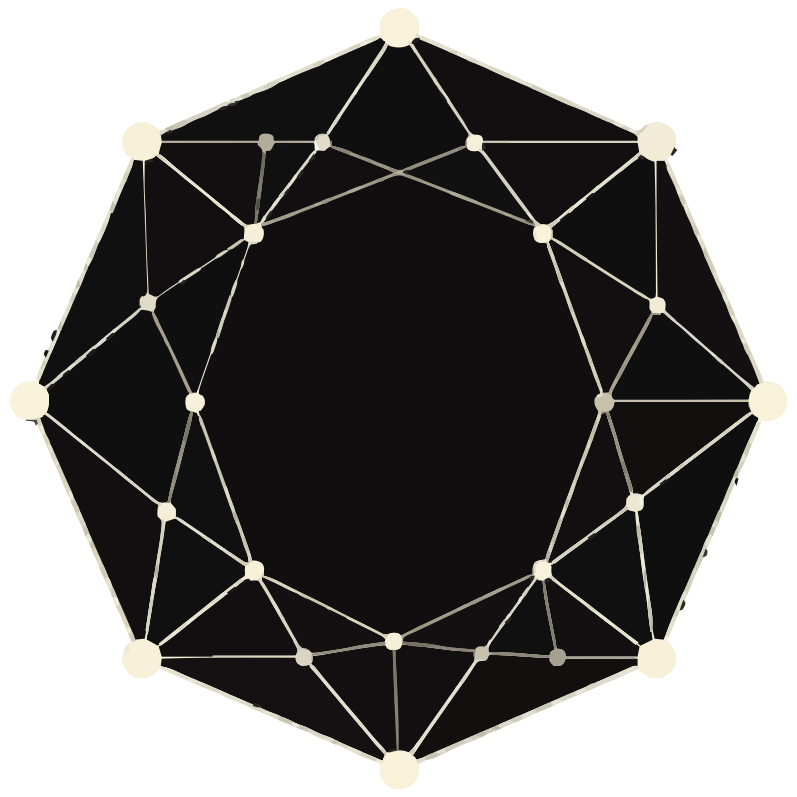
Knowing your functions exist is a start. The real value is knowing how they connect. As Oynix parses, it resolves the edges between symbols — which function calls which, which code reads or writes which data, which handler serves which route:
Because these are real edges — not guesses from similarity — Oynix can traverse them: follow a call three hops out, or find every piece of code that touches one table, by walking the graph. That's something a flat text search or an embedding pile simply can't do.
Code linked to the reasons behind it
Finally, the code graph is connected to the conversations and documents that shaped it — the pull request that introduced a function, the ticket that motivated it, the thread where the trade-off was settled. So the graph doesn't just know what the code is; it knows why it's there. That's the difference between a search index and a memory.
Why it changes the answers you get
When you ask Oynix "how does login work?", it doesn't return files that contain the word "login." It starts at the login entry point and follows the actual call chain — the handler, the token check, the user lookup — and explains that path. The answer is the real flow of your system, because the graph is the real structure of your system.
That's the whole point of parsing to structure first: understanding, instead of a confident guess.
Understanding, not guessing
Oynix turns your codebase into a queryable graph of real relationships — so answers, for you and your AI agents, are grounded in how the code actually fits together.
Join the waitlist →