Knowledge
One Graph Across Every Repository
No serious system lives in a single repository. There is the API, the shared library, the two services that both import it, the client that calls the API, and the tooling that stitches them together. The code is split across repos. The dependencies are not. That mismatch is where changes go wrong.
The Oynix Team · June 8, 2026 · 6 min read
Ask most code tools a question and they answer inside the boundary of one repository. That is fine until the thing you are changing is used somewhere else. Which, in a real organization, is most of the time.
The repository boundary is an artifact of how you store code. It is not a boundary of how your code actually depends on itself. Treating it as one is how a safe-looking change breaks a service three repos away.
What a per-repo view hides
- Cross-repo callers. A function in a shared library looks unused inside its own repo. It is called by four services that live elsewhere. A single-repo view shows none of them.
- Real ownership. The person who owns the code you are touching may not be in the repo you are in. Per-repo, you ask the wrong team.
- True blast radius. The impact of a change stops at the repo edge only in the tool. In production it keeps going. The gap between those two is an outage waiting to happen.
- Shared decisions. The decision that explains a pattern often lives in a ticket or thread attached to a different repo than the code that follows it.
A namespaced graph resolves them as one structure
The fix is not to merge your repositories. It is to stop letting the storage boundary govern what your memory can see.
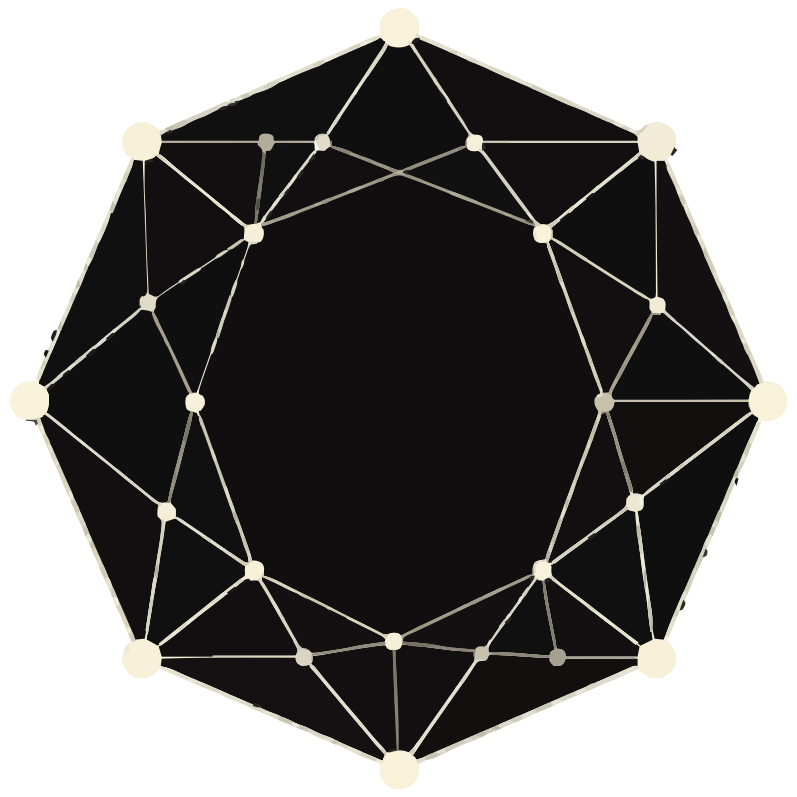
Oynix builds one graph and keeps it namespaced across every repository. Each repo has its own namespace, so nodes stay distinct and nothing collides. But the edges are free to cross namespaces. A caller in one repo connects to a definition in another as a single edge in a single graph.
The result is that a query does not stop at a repo wall. When your agent asks what calls this function or who owns this file or what a change touches, the answer is drawn from the whole structure, not a slice of it. The boundaries are still there for organization. They are just no longer blind spots.
One function, callers everywhere
A concrete cross-repo change
Say you want to change the signature of parseToken in a shared authentication library. Inside that repo, the search results look reassuring. A handful of tests, a couple of internal uses. Looks contained.
It is not. Walk the cross-repo edges and the real picture appears.
- 1
Find the callers
Following the calls edges across namespaces surfaces every caller, including the billing service, the auth service, and the gateway, none of which live in the library's repo.
- 2
Find the owners
Following the owns edges points you at the three teams that maintain those callers, so the right people review before anything ships.
- 3
Read the blast radius
The full reach of the change is the set of nodes those edges touch. You see it as one structure, not as three separate searches you have to remember to run.
- 4
Ship with the reasoning attached
Following the explains edges surfaces the decision behind the original signature, so you change it knowing why it was shaped that way in the first place.
Why this is memory, not search
You could, in theory, run a text search across every repository and grep for the function name. It would miss aliased imports, indirect calls, and anything that does not match the literal string. It would tell you nothing about owners or the decision behind the code. And you would rerun the whole thing on the next change.
A namespaced graph is memory. It persists, it stays current through incremental sync, and it already holds the cross-repo relationships as edges. You are not reconstructing the map every time. You are querying one that stays true as the code moves.
The data stays in your own database on your own infrastructure. Oynix ships the engine that builds and traverses the graph across your repositories. It never holds your code.
The payoff
Cross-repo changes are the scary ones precisely because the tools go quiet at the boundary. When the boundary disappears from your memory, the fear goes with it. You see the callers, the owners, and the reach before you touch a line.
Real organizations are many repositories. Your memory should be one graph.
See across every repository as one graph
Oynix keeps a namespaced graph across all your repos, so callers, owners, and blast radius resolve no matter where the code lives.
Install Oynix